
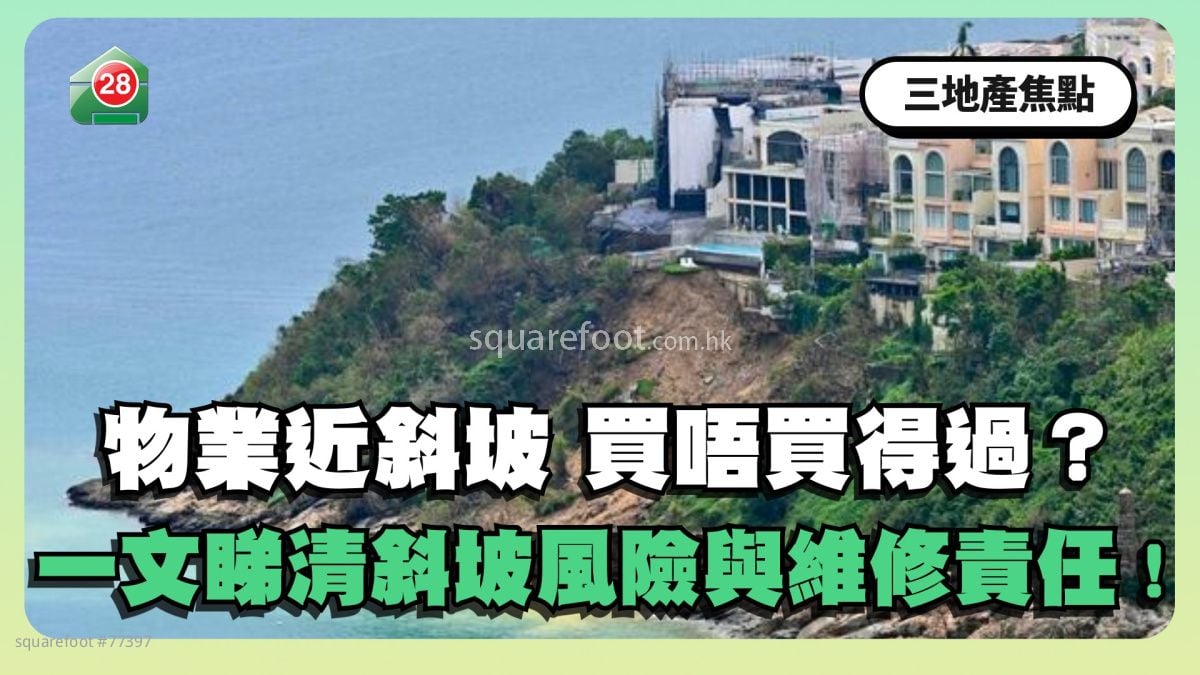
Different buyers have different requirements for their living environment. Some prefer convenient transport and comprehensive daily amenities, while others seek a quiet environment away from the hustle and bustle. Compared with densely populated urban developments, housing estates near slopes generally have fewer cases of buildings being very close to one another, and the living space and level of privacy are also relatively higher. So, are properties near slopes worth buying?
Undeniably, in terms of natural lighting, ventilation, views, and a quiet living environment, properties near mountains do have certain advantages. Together with a higher degree of privacy, they are naturally attractive to buyers who value quality of living. However, behind these advantages is an issue that should not be overlooked, and buyers must pay particular attention to it before entering the market.
What really needs attention is who is responsible for maintaining the slope. If a slope experiences soil erosion, ageing retaining walls, or even a risk of landslide, the slope safety authorities under the Civil Engineering and Development Department may issue a “Dangerous Hillside Order”, requiring the relevant parties to carry out remedial works within a specified period.
If there is a private slope within or adjacent to the housing estate, the relevant owners are responsible for the slope’s routine maintenance, regular inspections, and, where necessary, strengthening and disaster-prevention works. These maintenance expenses can easily be considerable.
Slope maintenance works are not ordinary minor repairs. Owners often need to hire professional geotechnical engineers to carry out surveys and design work, and the project costs can easily reach several million or even tens of millions of dollars. If the building has relatively few units, the maintenance cost apportioned to each owner will be higher, creating a heavy financial burden.
Moreover, a repair order cannot be ignored. A Dangerous Hillside Order is generally registered in the land title records of the relevant property until the order has been complied with. If the owners fail to deal with it as required, the Buildings Department may also carry out the works on their behalf and then recover the project costs and surcharges from the owners. Therefore, apart from safety concerns, an outstanding repair order may also affect future property transactions.
However, does having a slope next to a housing estate necessarily mean that the estate’s owners are responsible for its maintenance? Not always. It depends on the land boundary, land ownership, and the relevant government lease and land grant conditions. Some slopes are managed and maintained by government departments, but in some cases, even if a slope is located on government land, the relevant land grant conditions may still specify that the owners of the adjoining private lot are responsible for the slope’s repair and maintenance.
In other words, not all slopes located on government land are the government’s responsibility to maintain. What needs to be checked are the land grant conditions. If the conditions include a “slope maintenance clause”, the owners of the housing estate must bear responsibility for the repair and maintenance of that slope.
If you want to buy a housing estate near a slope and are worried that you may have to share a large slope maintenance bill in the future, how can you find out who is responsible? The most direct method is to check the Lands Department’s slope information system -- Systematic Identification of Maintenance Responsibility of Slopes in the Territory (SIMAR) -- and enter the housing estate name, address, and the slope number to find out whether the party responsible for maintenance is a government department or the owners.
However, the information in the Slope Maintenance Responsibility Information System (SMRIS) is more suitable as a preliminary reference. If you genuinely intend to purchase the property, it is best to appoint a lawyer to check the land registration records, deed of mutual covenant, and relevant land grant conditions to determine whether the property carries slope maintenance responsibilities. At the same time, you can also ask the management office or owners’ corporation whether the housing estate has carried out slope maintenance in the past, whether it has ever received a repair order, and whether any major slope works are planned in the future.