
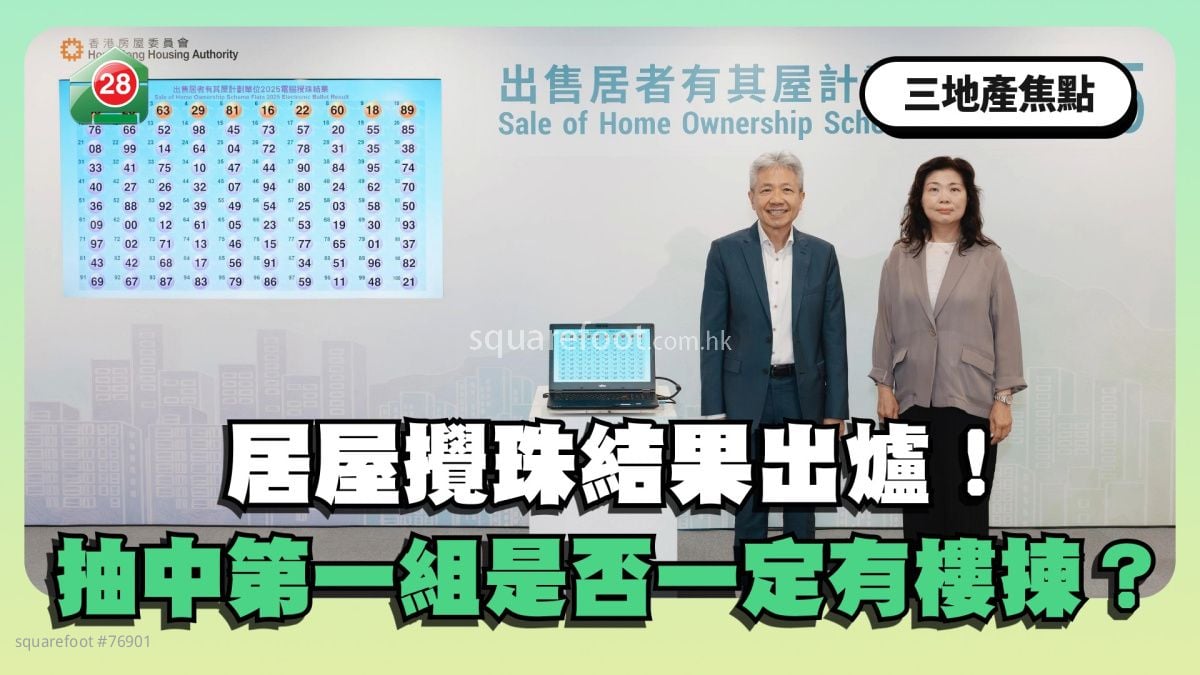
The ballot for the latest Home Ownership Scheme (HOS) was completed earlier, determining the order in which applicants will select flats. The first 10 ballot numbers for this round are 06, 28, 63, 29, 81, 16, 22, 60, 18 and 89. Flat selection is expected to take place in the third to fourth quarters of 2026.
Many applicants may find the HOS ballot results confusing and may not know whether they have a chance to select a flat. First, applicants need to understand their group number. The group number is based on the last two digits of the application number. Using this round as an example, if the first ballot number is “06” and the last two digits of your application number are also “06”, you belong to the first group.
The Housing Department will then use the ballot numbers and the priority order of different application categories to randomly arrange all applicants’ flat selection order by computer. Applicants can enter their full application number into the relevant list to check their flat selection order within their category.
At the beginning of the flat selection order list, applicants will see an English letter code representing their application category. For example, WP refers to White Form family applicants participating in the “Priority Scheme for Families with Elderly Members” and/or the “Priority Scheme for Families with Newborns”; WM refers to other White Form family applicants; and WS refers to White Form one-person applicants. There are more types of codes for Green Form applicants. Applicants can refer to the first page of the flat selection order list for the meaning of each code.
It is worth noting that the Government provides additional ballot numbers to applicants who meet certain conditions. Each applicant may be allocated up to three ballot numbers to increase their chances of success. The arrangements apply to applicants who had continuously applied for the HOS in the previous two rounds but were unsuccessful in purchasing a flat, as well as White Form young family and one-person applicants aged below 40 who participate in the “Youth Scheme (HOS)”. The system will ultimately use the number ranked highest in the ballot results to determine the applicant’s final flat selection order.
After finding out their flat selection order within their category, applicants need to understand the priority order and quotas for different application categories. Generally, families affected by clearance programmes will be arranged to select flats first, followed by families participating in the “Priority Scheme for Families with Elderly Members” (Priority Elderly Scheme) and “Families with Newborns Flat Selection Priority Scheme” (Priority Newborns Scheme). Other family applicants will follow, while one-person applicants will select flats last.
Using this round of the HOS as an example, the Government has reserved 2,800 quotas for families participating in the “Priority Scheme for Families with Elderly Members” or the “Priority Scheme for Families with Newborns”, with half allocated to Green Form applicants and half to White Form applicants. Another 700 quotas have been reserved for one-person applicants, also divided equally between Green Form and White Form applicants. A total of 6,926 flats are available under this round of the HOS. After deducting the reserved quotas above, 3,426 quotas remain for other family applicants.
The above figures show that even if an applicant draws the first ballot number, it does not necessarily mean that they will have a flat to select. Taking White Form one-person applicants in this round as an example, there are 51,072 applicants, but only 350 quotas have been reserved for them. In other words, the proportion of applicants who can successfully select a flat is only about 0.7%.
Therefore, when checking the flat selection order, if an applicant sees that their number is before WS000350, they will generally have a better chance of being invited to select a flat after passing the asset and income assessment. If anyone withdraws or fails to pass the assessment, subsequent applicants will be invited in order as replacements.